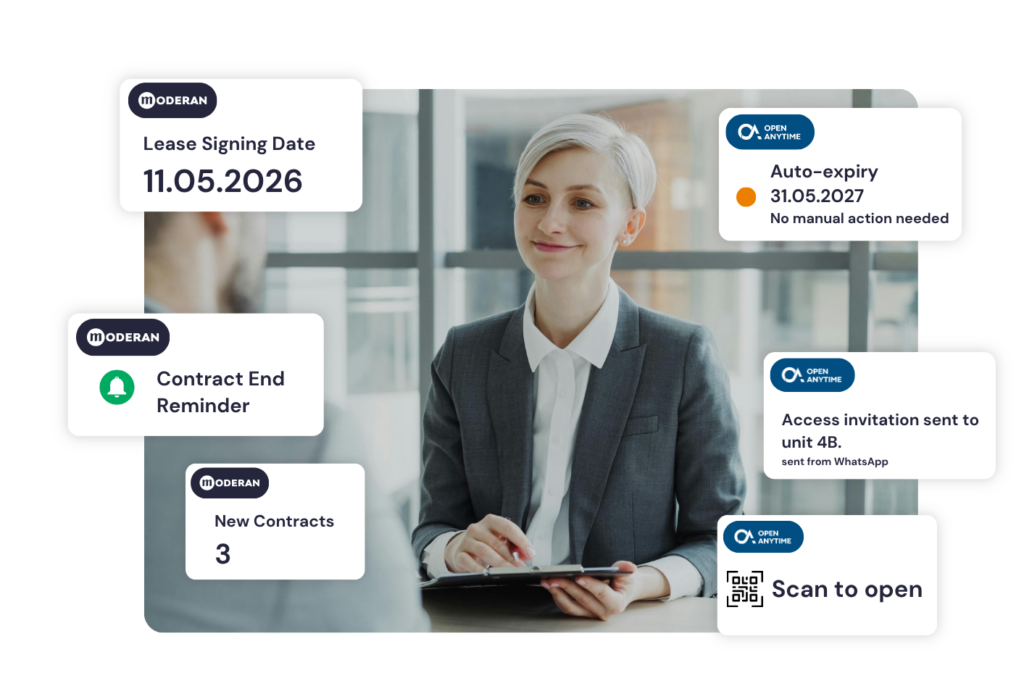
This article was created in collaboration between Moderan and Open Anytime, an Austria-based access management solution, to explore how modern access management can be integrated into and automated with property management software.
Property management today extends far beyond lease administration. Collecting rent and signing leases are just the beginning. Day-to-day operations also include keeping tenants satisfied, coordinating service providers, managing facilities, and overseeing systems across multiple buildings.
Some of those tasks are clearly ongoing. Others feel like one-time events that rarely stay that way.
Access management is a good example: keys are handed over, access cards are issued, permissions are set.
The task gets marked as done. If things go smoothly, you might not think about it again until rent is due or the lease ends.
However, in practice, it rarely stays that simple.
The access management challenge in property management software
As portfolios grow, access management becomes more than a minor administrative task. More tenants mean more move-ins, move-outs, and contract changes. Service providers rotate in and out for maintenance, inspections, cleaning, and repairs. Each visit requires access to be set up and then removed again.
Without a structured approach, these tasks pile up. Permissions get updated manually, access rights are not always revoked on time, and there is limited visibility into who can actually get into which areas.
This creates friction across everyday workflows:
- High administrative effort whenever tenants or service providers change
- Limited transparency over active access rights
- Security risks due to outdated or forgotten permissions
- Inefficient processes around key handovers and returns
“The problems always show up at transition points. A tenant moves out, a contractor finishes a job, and suddenly no one knows if the key was returned or if the key fob still works.”
Michael Pötsch , Sales Executive, Open Anytime
What goes wrong when access is managed separately
These issues rarely stem from access itself, but from the disconnect between operational data and physical access control.
When access management runs independently from tenant and lease data, problems tend to build up quietly. Staff often discover that fobs or keys were never returned, or that old credentials still unlock common areas. Each missing key forces a security review and delays turn-over work. Here are the most common failure points.
Access rights that outlive the lease
Physical keys and fobs often are not returned on time. When they go missing, teams have to rekey locks or re-programme systems. A lost master key can shut down operations for hours, and depending on the building, may require re-keying across multiple sites.

Vendor access that accumulates over time
Service providers often hold a general key or fob long after their contract ends. Over time, building owners lose track of who can still access which spaces. This is a security issue that is easy to overlook until something goes wrong.
Spreadsheets and paper logs that fall out of sync
When access lists are updated by hand, they stop reflecting reality. Staff do not know who currently has access or whether credentials have expired. Every discrepancy triggers a security review and pulls people away from more important work.
Last-minute requests that create operational stress
Coordinating access for cleaners, inspectors, or prospective tenants involves calls, emails, and physical key exchanges. Across a portfolio, these small interruptions add up into measurable costs in labor, delays, and tenant dissatisfaction.
“The buildings that stand to gain the most from integrated access management are often the ones with the most complex setups. Multiple buildings, different lease structures, a mix of long-term tenants and short-stay contracts. That is where manual processes break down the fastest, and where automation makes the biggest difference.”
Martin Schröder, Sales Manager & Data Protection Officer, Moderan
A more sustainable approach: connecting keys to property management data
Access rights are not static. In property management, they are directly tied to operational events: lease start and end dates, tenant changes, service provider visits. Managing access effectively means keeping it aligned with the data that already governs these events. This is where the integration between lease management systems like Moderan and access platforms like Open Anytime becomes critical.
When access management runs separately, every change requires manual coordination. Someone has to make sure access is granted or revoked at the right time. That dependency on manual steps is where most of the errors and delays come from.
Embedding access management into existing property management software removes that dependency. When access follows real operational changes automatically, the coordination work largely disappears.
How this works in practice
Permanent access for tenants
In a traditional workflow, leasing teams hand out physical keys during move-in and rely on tenants to return them at move-out. Keys are sometimes copied without notice, spreadsheets are updated manually, and when someone forgets to return a key, locks need to be changed or reprogrammed. That is expensive and delays the make-ready process.
Connecting access to lease lifecycle data changes this:
- Once a lease is marked active in Moderan, Open Anytime automatically issues digital credentials via the tenant’s preferred channel (WhatsApp or email). The credential is valid from the official move-in date and limited to the relevant areas: the apartment, parking, and shared amenities.
- When the lease end date is reached, access is revoked automatically. There are no “ghost” credentials, no need to track down keys, and no lock re-keying.
- Different contract types can map to different access bundles. Co-working tenants might get 24/7 access to shared workspaces, while residential tenants can only access amenities during specific hours.
- Access events are logged centrally. For non-residential tenants, managers can answer the question of who has access to a given unit and why, instantly.
Temporary access for service providers
In many buildings, maintenance and cleaning teams still collect keys from an office or rely on master codes that never change. Coordinating visits involves phone calls and follow-ups. When something goes wrong, there is no reliable record of who was on site or when.
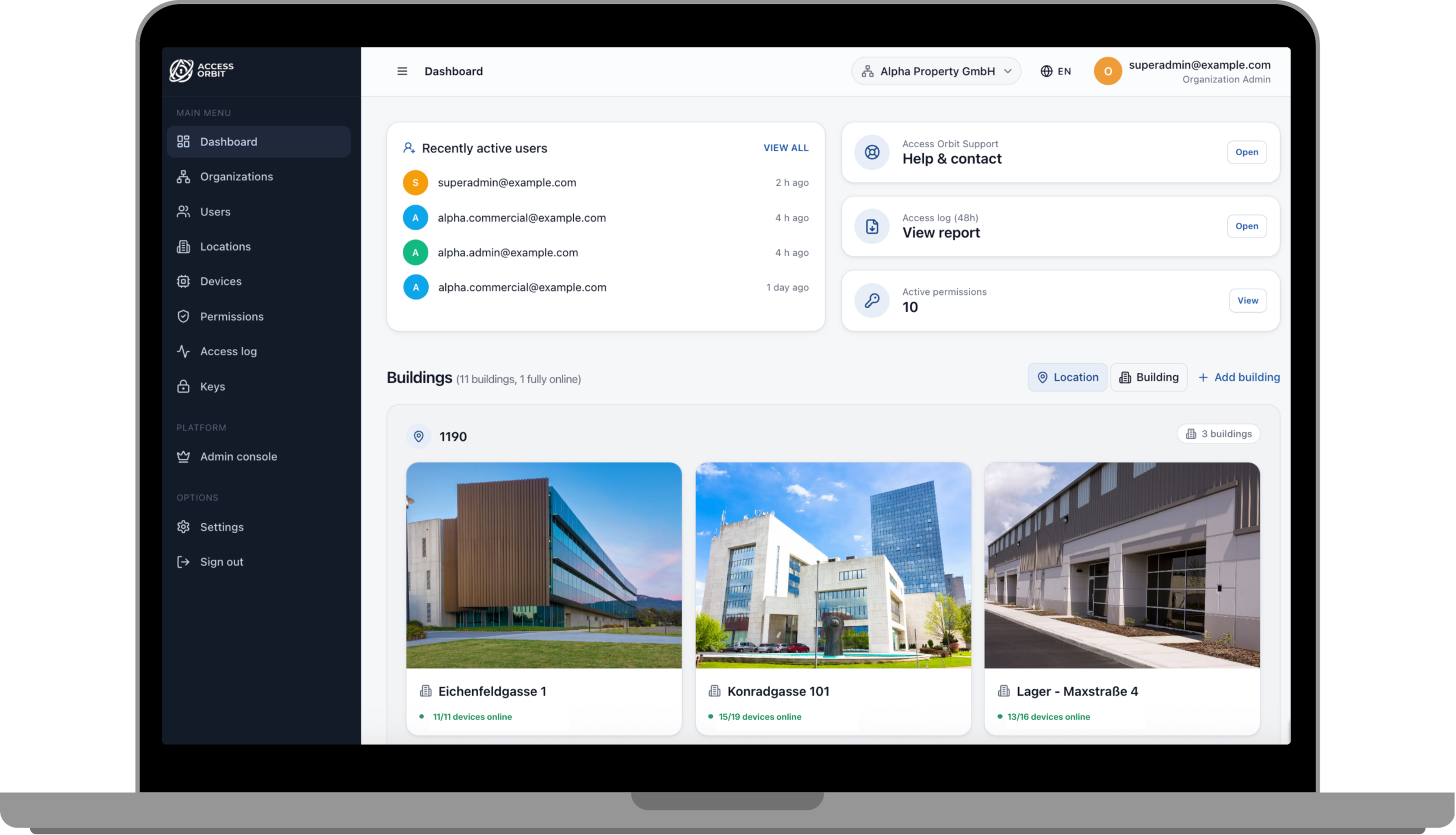
With time-bound, role-based access through Open Anytime, this works differently. Service providers receive a digital credential that is valid only for their scheduled window. It is sent automatically via their preferred messaging channel, no key pickup required. When the window closes, the credential expires on its own.
Access permissions are tied to the specific task. A cleaning crew can unlock the relevant common areas. A technician gets access to the server room and nothing else. Building staff see a real-time log of who entered and when, and can issue or revoke access remotely without needing to be on site.
“Most of the clients we work with are not dealing with one big crisis. They are dealing with a hundred small ones. A key that was not returned. A contractor who still has access from six months ago. A new tenant waiting on move-in day because the credential was not set up in time. When you see it across a whole portfolio, it becomes clear how much time is being spent on things that should just happen automatically.”
Michael Pötsch, Sales Executive, Open Anytime
Why existing buildings benefit most
A common misconception in the market is that modern access management only makes sense in new construction. In practice, existing buildings often benefit the most.
Many owners assume that modernizing access requires replacing all existing hardware and standardising on a single vendor. That is rarely the case. A hardware-agnostic platform can work with existing building infrastructure, support a mix of locks and readers from different manufacturers, and be rolled out gradually across a portfolio.
- Mixed hardware environments are supported. Open Anytime works with brands including SALTO, dormakaba, and ASSA ABLOY, so each space can be equipped according to its specific needs.
- Retrofitting is possible without rebuilding. Smart locks and readers are added to the existing infrastructure and integrated into a unified control layer step by step.
- Incremental rollout preserves capital and avoids vendor lock-in. Property owners can start with one building or one floor and expand as needed.
Data protection, transparency, and control
One of the less obvious benefits of integrated access management is what it does for visibility. With manual systems, it is genuinely difficult to answer the question: who currently has access to this building, this floor, this unit, and why?
With digital access tied to lease and contract data, that answer is always available. Every permission is tied to a specific person, a specific reason, and a specific time window. Every entry is logged. Changes are applied instantly and recorded.
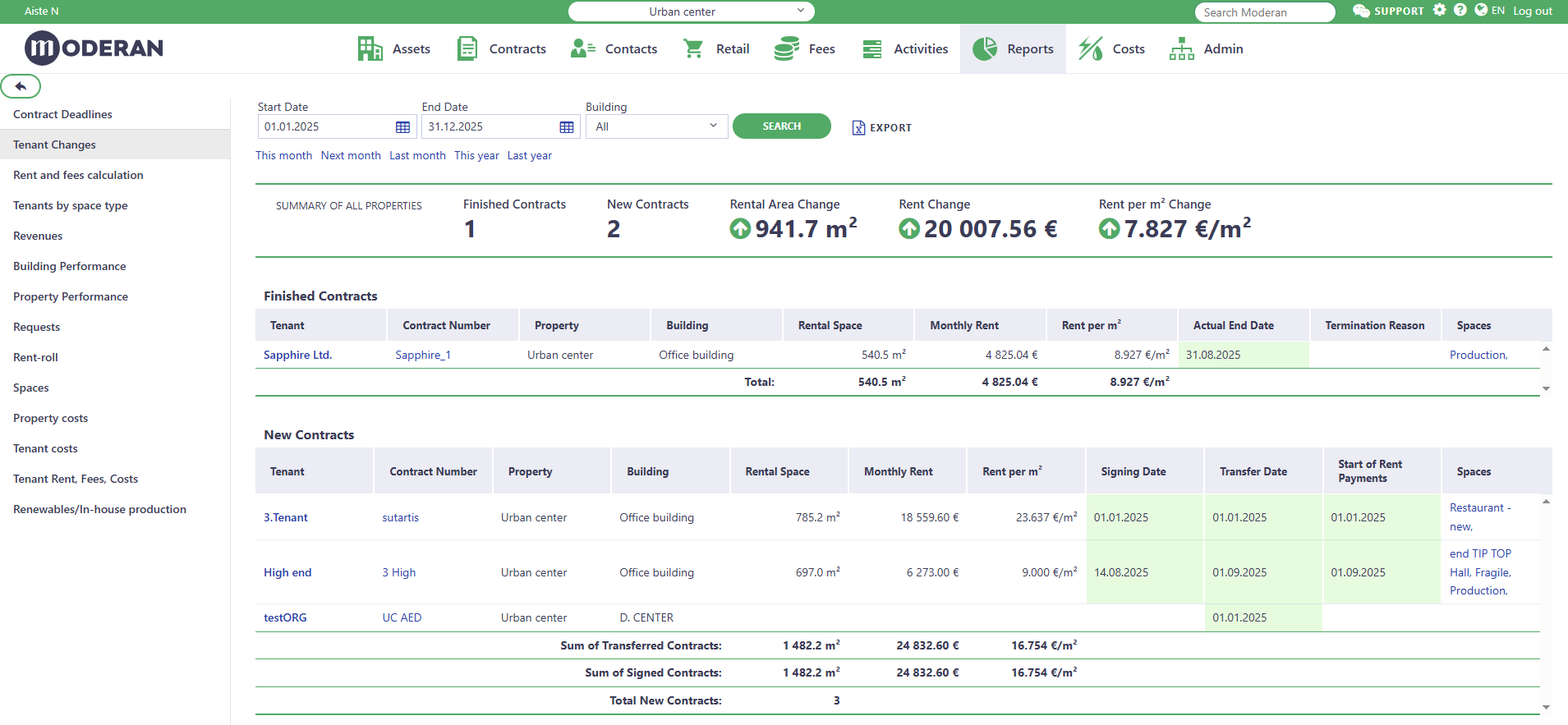
For property owners and asset managers, this kind of transparency matters. It means fewer surprises, faster responses when something does go wrong, and a clear picture of what is happening across the portfolio at any given moment.
This level of transparency is only achievable when access management is directly connected to underlying lease and tenant data.
“The lease data is already there. The tenant information is already there. What integrated access management does is make sure the physical reality of your buildings reflects what your data says. When a lease ends, access ends. When a new tenant moves in, access is ready. That alignment between your records and what is actually happening on the ground is where you get real transparency.”
Martin Schröder, Sales Manager & Data Protection Officer, Moderan
How Moderan and Open Anytime work together
Moderan is the central platform for managing tenant data, leases, and service providers across property portfolios. Open Anytime provides the access management layer that puts those records into practice at the door. The result is not just integration, but process continuity across digital and physical operations.
The two systems connect via API. When something changes in Moderan, the relevant access rights in Open Anytime update accordingly. Property teams do not have to manage both sides manually. The data does the work.
This kind of integration is not accidental. It reflects a deliberate approach to how Moderan is built.
“Moderan is not trying to do everything. We do lease management, tenant data, and portfolio operations well, and we build our integration ecosystem around partners who have the same focus in their own area. Open Anytime is a good example of that. They do access management well. The integration works because both tools are doing what they are actually built for.”
Martin Schröder, Sales Manager & Data Protection Officer, Moderan
What this means operationally
For property teams, the day-to-day impact is straightforward. Less time spent on key logistics, fewer follow-ups with contractors, and no more manual updates every time a lease changes. New tenants receive credentials automatically on move-in day. Former tenants lose access automatically when the lease ends.
As portfolios grow, access management does not have to grow proportionally in terms of staff time. The volume of doors, tenants, and service providers can increase without adding coordination overhead.
“Based on what we see with clients, up to 70% of the manual coordination work around access can be eliminated once it is automated and tied to existing data. That is not a small number when you consider how much time property teams spend on this every week.”
Michael Pötsch, Sales Executive, Open Anytime
For property owners and asset managers, this is a practical step toward operations that scale without adding complexity. Access management becomes part of the workflow, not a separate task running alongside it.
Interested in exploring this integration?
If you would like to understand what the Moderan and Open Anytime integration could look like for your portfolio, reach out to Martin Schröder for a live demo. We are happy to set up a call and walk through it.
About Moderan
Moderan is a property management platform built for portfolio-scale operations. It connects lease management, tenant data, and operational workflows in one place.
About Open Anytime
Open Anytime is an Austria-based access orchestration solution. Its hardware-agnostic platform enables time-bound, role-based access management for properties of all types and sizes. For more information contact Michael Pötsch for a live demo.